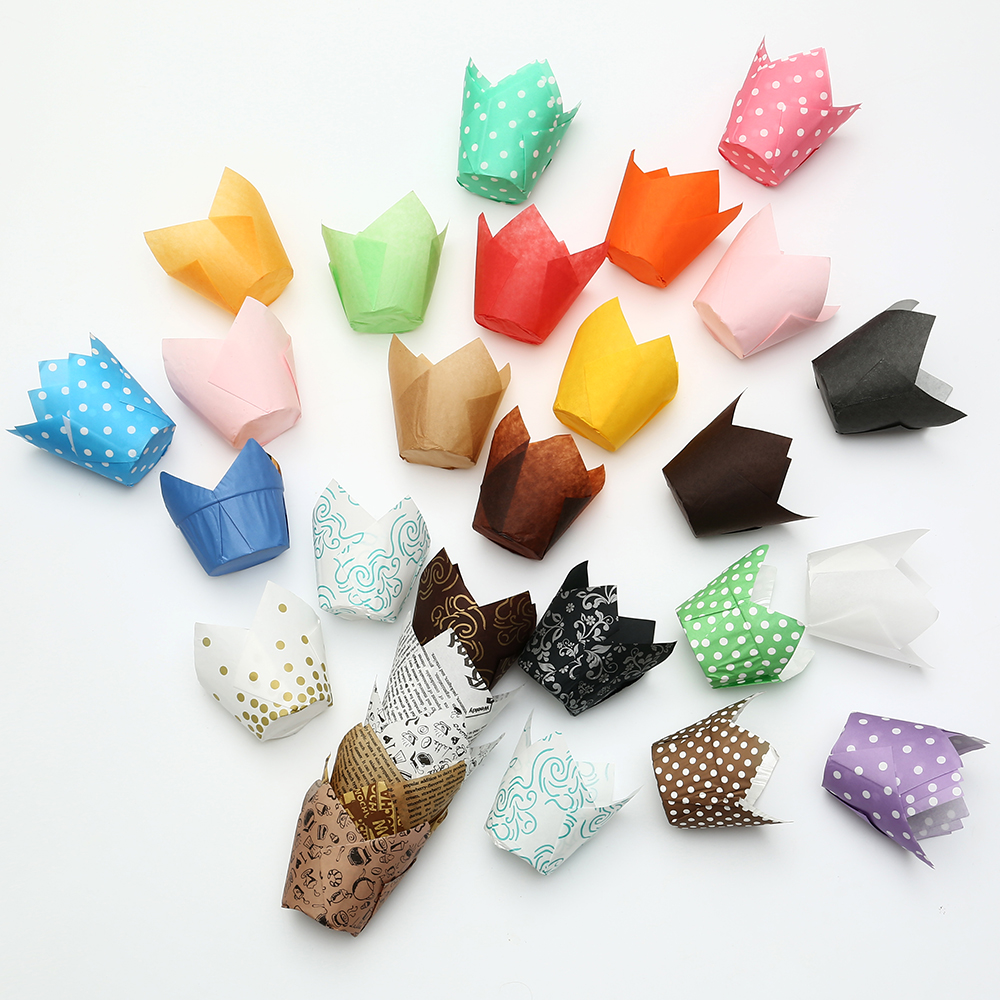
In a crowded marketplace, your packaging is your loudest brand ambassador. A custom printed cupcake liner does more than hold a cake; it holds your logo, your colors, and your promise to the customer. It transforms a disposable commodity into a premium, branded asset. But the journey from a digital logo on your computer screen to a physical liner on a bakery shelf is a complex industrial process. This guide demystifies the world of custom printing, explaining the technology, the costs, and the critical decisions you must make to bring your branded vision to life.
1. The Printing Technologies: Flexography vs. Digital
There are two primary methods for printing on cupcake liners.
2. The Artwork Setup: Designing for a Curved Surface
Your logo on a flat computer screen will look different on a curved, pleated cup.
-
The "Distortion" Factor: The liner has vertical pleats. Your design will be broken up by these pleats. Fine lines and small text may become unreadable.
-
The "Seam" Issue: The liner has a seam where the paper overlaps. Your design must be "stepped off" or repeated in a way that it doesn't look broken or misaligned at the seam.
-
The "Wrap" Effect: The design wraps around the circumference of the liner. You must provide a "flat wrap" artwork file that accounts for the curve.
-
The "Safe Zone": Keep all critical text and logos at least 1/4 inch away from the top and bottom edges of the liner. These areas are most prone to folding and wear.
3. Color Matching: The Pantone System
Screen colors (RGB) and print colors (CMYK) are different. What looks vibrant on your monitor may look dull when printed on brown kraft paper.
-
The Solution: Use the Pantone Matching System (PMS). Provide your printer with specific Pantone codes for your brand colors. This ensures color consistency across all your packaging.
-
The "Kraft" Challenge: Printing light colors (like yellow or light blue) on unbleached kraft paper is difficult. The brown base will dull the ink. You may need to use opaque, high-density inks or opt for a "knockout" effect (leaving the paper color as part of the design).
4. The Plate Fee: A Necessary Investment
For Flexographic printing, you must pay a plate fee (also called a cylinder fee).
-
What it is: The cost to create the custom rubber or polymer printing plates for your design.
-
The Cost: Typically $50 - $150 per color. A 4-color design will cost $600 in plates.
-
The Ownership: You own these plates. They are stored by the factory and can be reused for future re-orders, saving you the plate fee next time.
-
The "One-Time" Nature: This is a one-time, non-refundable cost. It is the primary barrier to entry for small businesses.
5. The MOQ (Minimum Order Quantity)
Custom printing requires a significant commitment.
-
Flexo Printing: MOQ is typically 100,000 - 300,000 pieces per design. Factories need to run large batches to amortize the plate fee and setup time.
-
Digital Printing: MOQ can be as low as 5,000 - 10,000 pieces. This makes it accessible for small bakeries and startups.
-
The "Run Length" Factor: The longer the production run, the lower the cost per unit. A 300,000-piece run will be significantly cheaper per liner than a 100,000-piece run.
6. Food-Grade Inks: Safety is Non-Negotiable
This is the most critical aspect of custom bakery packaging. The inks must be safe for direct food contact.
-
Low Migration (LM) Inks: These are specifically formulated to be "locked" onto the paper. They do not bleed, flake, or migrate into the food, even under high heat and in the presence of fats.
-
UV-Cured Inks: These inks are cured instantly with ultraviolet light, creating a dry, solid, and non-toxic layer. They are highly resistant to abrasion and grease.
-
The "Heavy Metal" Ban: Ensure your printer uses inks that are free from heavy metals (lead, cadmium, mercury) and comply with FDA, EU, and LFGB regulations.
-
The Certification: Request a Certificate of Compliance and a Heavy Metal Test Report from a third-party lab (like SGS or Intertek).
7. The Production Timeline: Patience is a Virtue
Custom printing is not a fast process.
-
The Steps: Artwork Approval -> Plate Making (3-5 days) -> Printing (3-7 days) -> Die-Cutting (2-3 days) -> Packaging (2-3 days) -> Quality Control (1-2 days) -> Shipping (30-45 days by sea).
-
The Total Time: Expect 60-90 days from the day you approve the artwork to the day the goods arrive at your warehouse. Never promise a delivery date to your customers until you have a firm production and shipping schedule.
8. The "Golden Sample" Protocol
Before the factory runs your entire order, they will produce a Pre-Production Sample (PPS), also known as the Golden Sample.
-
Your Role: You must physically inspect this sample. Check the color accuracy, the print registration (no blurry edges), the ink adhesion (does it scratch off easily?), and the food safety (does it have an odor?).
-
The Approval: Sign off on the sample. This sample becomes the "gold standard" against which the entire bulk production will be judged. If the bulk order doesn't match the Golden Sample, you have grounds to reject the shipment.
9. Cost Breakdown: What Are You Paying For?
A quote for custom printed cupcake liners will include:
-
Material Cost: The paper, coating, and base material.
-
Printing Cost: The cost of the ink and the press time.
-
Plate Fee: The one-time cost for the printing plates.
-
Die-Cutting Cost: The cost to cut the liners into their final shape.
-
Packaging Cost: The cost of the retail box or polybag.
-
Shipping & Duties: The cost to get the goods to your door (usually not included in the factory quote).
10. B2B Strategy: Maximizing Your ROI
-
The "House Blanks" First: Before investing in custom printing, test the market with high-quality "House Blanks" (like gold foil or kraft liners). Once you have proven demand, invest in custom printing.
-
The "Evergreen" Design: Create a custom design that is not tied to a specific season or promotion. This allows you to sell the liners year-round, maximizing your inventory turnover.
-
The "Combo" Offer: Bundle your custom liners with other products (like custom boxes or stickers) to increase the average order value.
-
The "Story" on the Liner: Use the liner as a canvas to tell your brand story. Include your website, social media handles, or a QR code that links to a recipe or a promotion.
Conclusion: Your Brand, Your Liner, Your Legacy
Investing in custom printed cupcake liners is a significant step for any baking brand. It elevates your product, reinforces your identity, and creates a memorable unboxing experience. By understanding the printing process, demanding food-grade safety, and planning for the long lead times, you can navigate the complexities of private label manufacturing and create a packaging asset that truly reflects the quality of your baked goods.